


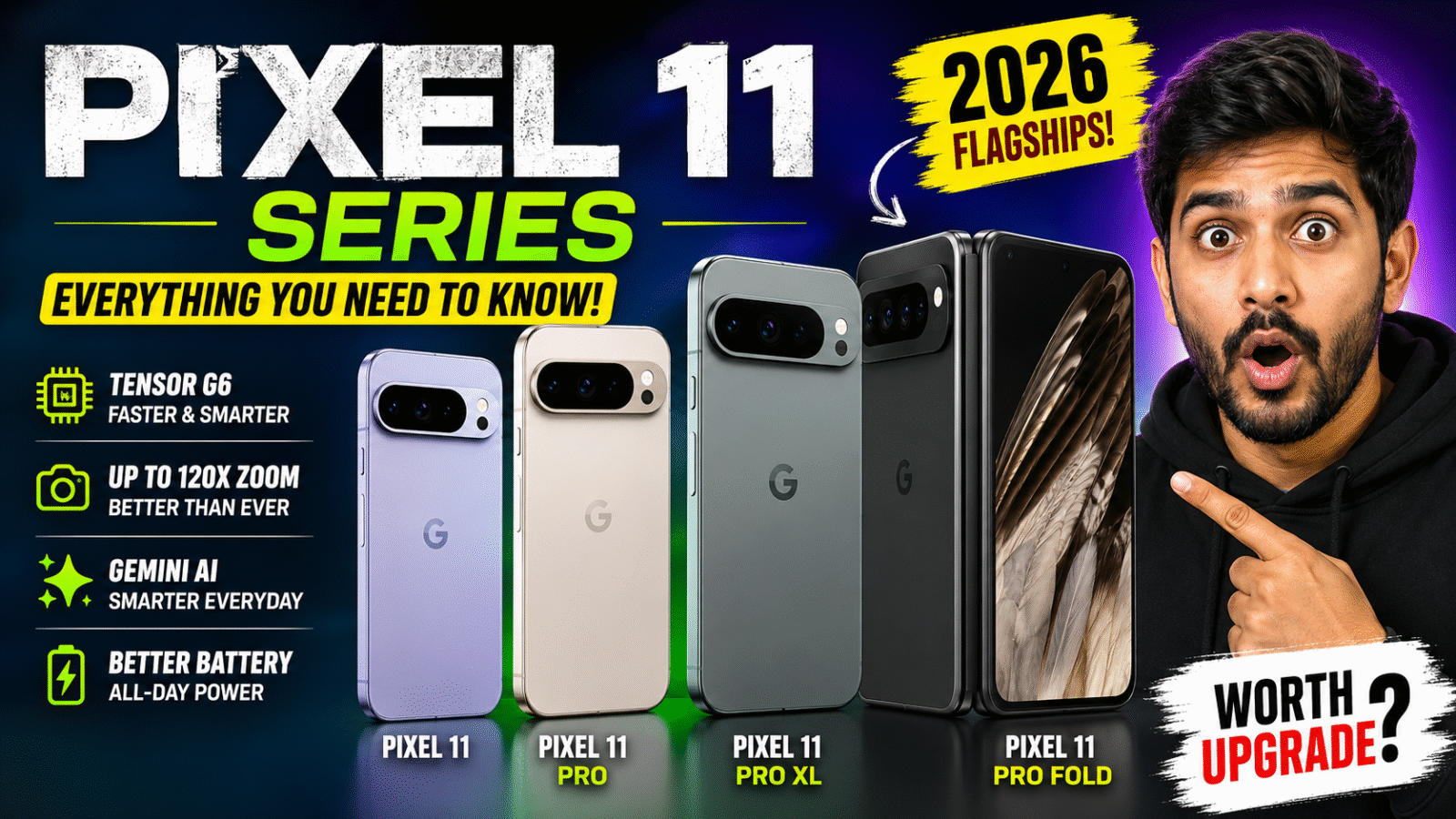
Google has officially unveiled its new Pixel 11 smartphone family, bringing together the Pixel 11, Pixel 11 Pro, Pixel 11 Pro XL and Pixel 11 Pro Fold. The new generation focuses heavily on artificial intelligence, photography, performance and a more refined hardware design.
The Pixel 11 series was introduced at Google’s Made by Google 2026 event on August 12, with prices starting at around $899 for the standard Pixel 11 in the US.
Pixel 11 Series: Four Models
Google has expanded the Pixel family into four flagship models:
- Pixel 11 – the standard flagship
- Pixel 11 Pro – premium compact model
- Pixel 11 Pro XL – larger premium flagship
- Pixel 11 Pro Fold – Google’s flagship foldable
All four models are built around Google’s new Tensor G6 platform and Google’s increasingly AI-focused Android experience.
New Tensor G6 Chip
One of the biggest changes is Google’s next-generation Tensor G6 processor.
The new chip is designed to improve both conventional performance and Google’s AI workloads. Reports indicate that the Tensor G6 uses a new CPU architecture and an upgraded AI processing system, while Google has also introduced a newer Titan security chip and a different modem strategy.
Google’s approach is different from simply chasing benchmark scores. The Tensor platform is primarily designed to power features such as computational photography, Gemini AI, voice processing and real-time translation.
For everyday users, that means the biggest improvements may be experienced through the phone’s software rather than simply through faster app-loading times.
A More Refined Design
The Pixel 11 generation doesn’t completely abandon Google’s familiar Pixel design language. Instead, Google has refined it.
The most noticeable change is the slimmer camera bar, giving the phones a cleaner appearance while maintaining the distinctive Pixel identity.
Google has also introduced HiLight, an LED-based notification feature integrated around the rear camera area. It can provide visual notifications associated with contacts, giving the rear of the phone a new interactive element.
The result is a Pixel design that feels familiar while introducing a few new visual details.
Camera Upgrades
Photography remains one of the biggest reasons to consider a Pixel phone.
The Pixel 11 lineup brings improvements to camera hardware and Google’s computational photography system. The Pro models receive the most significant upgrades, including improved low-light photography and an enhanced zoom system capable of reaching up to 120x with Google’s computational processing.
Google has also introduced new camera and video features designed to make content creation easier.
Magic Capture
Magic Capture is designed to make it easier to capture moments from photos and video without requiring users to manually repeat shots.
Pro Stable Video
For creators, Google’s new 8K Pro Stable Video technology combines high-resolution recording with improved stabilization.
Camera Looks
Google is also giving users more control over the appearance of their photographs through customizable Camera Looks, allowing users to create a more distinctive visual style.
These features demonstrate Google’s strategy of combining upgraded camera hardware with AI-powered image processing.
Gemini AI Takes Center Stage
Artificial intelligence is arguably the biggest theme of the Pixel 11 series.
Google is integrating Gemini more deeply into the operating system, allowing the phone to perform more useful tasks instead of functioning only as a traditional voice assistant.
The new Pixel generation introduces features including improved voice-to-text, real-time translation and AI-assisted interactions.
Google is essentially positioning the Pixel 11 as an AI-first smartphone.
Rather than making AI a separate application, Google wants it to become part of the camera, communication, search and productivity experience.
Display and Battery
The Pixel 11 Pro and Pro XL are designed for users who want premium displays.
The Pro XL offers a larger 6.8-inch display, while the standard Pro model remains more compact. The Pro phones also feature high-refresh-rate displays and increased brightness.
Battery life has also received attention, with Google claiming improvements that can help the phones last through demanding days.
The company has also improved charging capabilities, including faster wireless charging on the new generation.
Pixel 11 vs Pixel 11 Pro vs Pixel 11 Pro XL
| Feature | Pixel 11 | Pixel 11 Pro | Pixel 11 Pro XL |
|---|---|---|---|
| Positioning | Standard flagship | Premium flagship | Large premium flagship |
| Processor | Tensor G6 | Tensor G6 | Tensor G6 |
| RAM | 12GB | Up to 16GB | Up to 16GB |
| Display | 6.3-inch class | 6.3-inch class | 6.8-inch class |
| Refresh rate | High refresh rate | 120Hz | 120Hz |
| Zoom | Up to 30x | Up to 120x | Up to 120x |
| Front camera | Standard | 42MP | 42MP |
| Storage | Starts at 256GB | Up to 1TB | Up to 1TB |
Specifications can vary by market and configuration.
Pixel 11 Pro Fold
The most ambitious member of the family is the Pixel 11 Pro Fold.
It combines Google’s Pixel software and AI features with a foldable form factor. The device is aimed at users who want a larger screen for multitasking while retaining the functionality of a flagship smartphone.
The Fold model also receives high-end specifications, including 16GB RAM, substantial storage and a large internal OLED display.
Pricing
Google has moved the Pixel lineup further into premium territory this year.
Reported US starting prices are approximately:
- Pixel 11: $899
- Pixel 11 Pro: $1,099
- Pixel 11 Pro XL: $1,299
- Pixel 11 Pro Fold: $1,899
The higher prices reflect the more advanced hardware and expanded AI capabilities, although regional pricing can differ considerably.
Is the Pixel 11 Series Worth Buying?
The Pixel 11 series looks less like a complete redesign and more like a major refinement of Google’s flagship formula.
The biggest reasons to consider the Pixel 11 are:
- Powerful new Tensor G6 platform
- Deep Gemini AI integration
- Improved Pixel photography
- Better long-range zoom on Pro models
- Enhanced video stabilization
- Refined camera-bar design
- Premium displays
- Improved charging and battery performance
- Long-term software support
For photography enthusiasts, the Pixel 11 Pro could be the most attractive model because it combines the compact form factor with Google’s most advanced camera and AI features.
For users who prefer a large display and maximum battery capacity, the Pixel 11 Pro XL is the obvious choice.
Meanwhile, the standard Pixel 11 could offer the best balance between flagship features and price.
The Google Pixel 11 series represents Google’s vision of the next generation of AI-powered smartphones.
Instead of concentrating solely on raw specifications, Google has focused on making AI useful throughout the phone—from photography and video to translation, communication and everyday assistance.
The Tensor G6, upgraded cameras, Gemini Intelligence, Magic Capture, Pro Stable Video and HiLight notifications make the Pixel 11 family one of Google’s most feature-packed smartphone generations yet.
The biggest question will be whether Google’s software and AI advantages are enough to justify the higher prices against powerful competitors from Apple, Samsung and other Android manufacturers.
If Google’s AI ecosystem continues to improve at this pace, the Pixel 11 could become one of the most important Android flagship launches of 2026.










Hi
hello